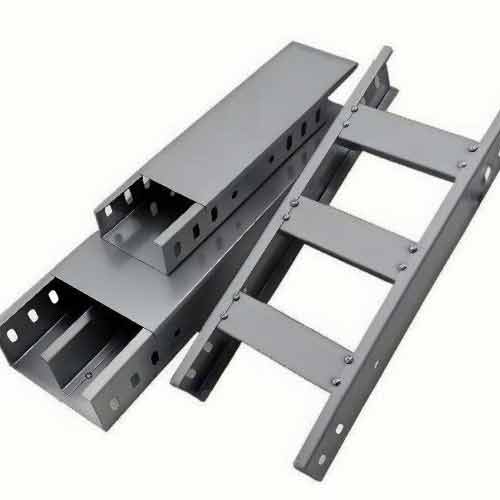
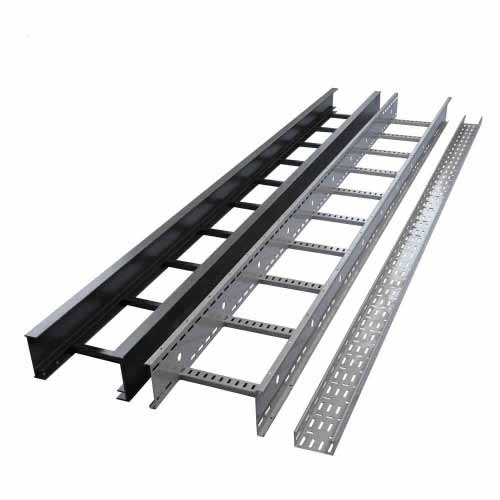
Product details description
Cable ladders are essential for routing and supporting electrical and data
cables in industrial facilities, requiring verified load capacity to prevent
failure under cable weight, maintenance loads, and dynamic forces. Rigorous
testing grounded in structural engineering principles ensures safety and
compliance with standards.
Load capacity testing begins with defining loading scenarios. Static loads
simulate the weight of fully loaded cable trays, including bundled conductors
and accessories. Dynamic loads account for maintenance personnel walking on the
ladder and transient forces from equipment vibration. Wind and seismic loads may
also be considered for outdoor or seismically active installations.
Structural analysis informs test parameters. Engineers calculate maximum
expected loads using tributary area methods, factoring in cable density and
distribution. Material properties (yield strength of steel, aluminum) and
cross-sectional geometry (ladder rung spacing, rail thickness) determine
stiffness and strength. Finite element analysis (FEA) models predict stress
concentrations and deflection under load, guiding test setup.
Testing procedures follow standards such as IEC 61537 or NEMA VE 1.
Specimens are instrumented with strain gauges and displacement transducers.
Incremental loads are applied until reaching design load and ultimate load, with
readings recorded to validate calculations. Deflection limits (e.g., L/180 for
live loads) ensure serviceability, while safety factors (typically 1.5–2.0 for
static loads) provide margin against unexpected overloads.
Test results validate design assumptions and manufacturing consistency.
Variations in weld quality, material defects, or dimensional deviations can
reduce capacity, so batch testing ensures uniformity. Certification marks from
third-party labs (UL, TüV) confirm compliance, enabling use in regulated
industries. Periodic retesting after installation detects degradation from
corrosion or mechanical damage.
Safety factor calculations integrate test data with real-world conditions.
Engineers add allowances for load uncertainty, environmental effects
(temperature, corrosion), and aging. For critical systems, higher safety factors
may be mandated. Documentation of test methodology and results supports forensic
analysis in case of failure. By combining empirical testing with analytical
rigor, cable ladder load capacity verification delivers reliable cable
management infrastructure.
Previous article:
The Role of Cable Ladders in Data Centers: Managing High-Density Cabling with Minimal Heat Buildup
Next article:
Cable Ladder Cutting and Fabrication: Field Modifications and Custom Length Solutions