Product details description
The selection of appropriate materials for cable ladder systems in
industrial environments requires careful consideration of corrosion protection
mechanisms, lifecycle cost implications, and performance requirements across
diverse application contexts. Cable ladders serve as essential infrastructure
for power and data cable management in manufacturing facilities, data centers,
commercial buildings, and infrastructure installations, supporting substantial
cable loads while facilitating installation, maintenance, and modifications
throughout the facility lifecycle. The aggressive atmospheric conditions present
in many industrial environments—including high humidity, chemical vapors, salt
spray, and temperature extremes—demand robust corrosion protection strategies
that ensure long-term structural integrity and safe cable support. The choice
between galvanized steel and stainless steel cable ladder systems represents a
fundamental decision point that influences initial project costs, ongoing
maintenance requirements, and expected service life in the specific
environmental conditions of each installation.
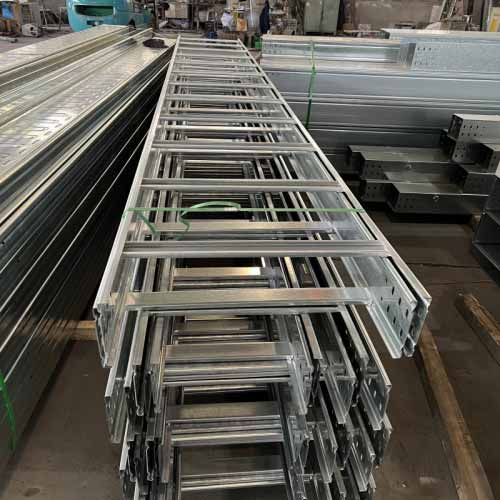
Galvanized steel cable ladder systems utilize zinc coating to provide
sacrificial corrosion protection that has proven effective in countless
industrial installations over many decades of service. The galvanization process
applies a protective zinc layer to steel components through hot-dip galvanizing,
where fabricated ladder sections are immersed in molten zinc to achieve coating
thicknesses typically ranging from 3 to 5 mils for standard industrial
applications. The zinc coating protects the underlying steel through two
mechanisms: barrier protection that isolates the steel from corrosive
environments, and sacrificial protection where zinc preferentially corrodes
instead of the steel at any points where the coating may be compromised.
Galvanized steel cable ladders offer an attractive combination of strength,
cost-effectiveness, and established performance history, making them the default
choice for many industrial applications where environmental conditions fall
within moderate severity levels. The predictable corrosion rate of zinc allows
engineers to estimate coating longevity and plan for maintenance activities such
as field-applied zinc-rich paints at coating损伤 locations.
Stainless steel cable ladder systems provide superior corrosion resistance
through the chromium-rich passive oxide layer that spontaneously forms on
stainless steel surfaces, providing inherent protection against a broader range
of corrosive environments than galvanized coatings can offer. The passive layer
self-repairs when damaged in the presence of oxygen, providing a self-healing
characteristic that maintains corrosion resistance even at minor surface
scratches and abrasions that would breach galvanized coatings. Common stainless
steel grades for cable ladder applications include Type 304, which offers
excellent resistance to most industrial environments and is generally adequate
for atmospheric exposures, and Type 316, which provides enhanced resistance to
chlorides and acidic conditions making it suitable for coastal installations,
chemical processing facilities, and wastewater treatment environments. While
stainless steel cable ladders command premium initial costs compared to
galvanized alternatives, the reduced maintenance requirements and extended
service life in aggressive environments can deliver favorable lifecycle cost
comparisons for applications where corrosion performance is critical.
The decision between galvanized steel and stainless steel cable ladder
systems should incorporate comprehensive analysis of environmental exposure
conditions, lifecycle cost projections, and facility-specific requirements that
vary significantly across different industrial contexts. Environmental severity
classification systems, such as those defined in ISO 12944 for atmospheric
corrosivity categories, provide standardized frameworks for assessing exposure
conditions and determining appropriate material selections. Facilities located
in coastal environments with salt spray exposure, chemical processing plants
with halogenated compound vapors, or wastewater treatment facilities with high
humidity and hydrogen sulfide levels typically warrant stainless steel ladder
systems despite higher initial costs. Facilities in moderate industrial
environments with occasional chemical exposures but no specific corrosion
challenges may achieve satisfactory performance from galvanized systems with
appropriate maintenance provisions. The integration of cable ladder systems with
other facility components, including cable tray, conduit, and structural
supports, should also inform material selection decisions to ensure consistent
corrosion protection across the complete cable management system and avoid
galvanic corrosion at dissimilar metal junctions.
Previous article:
Cable Ladder Materials Guide: Steel, Aluminum, and FRP Options for Corrosive Environments
Next article:
Hot-Dip Galvanized Cable Ladder - Superior Rust Protection